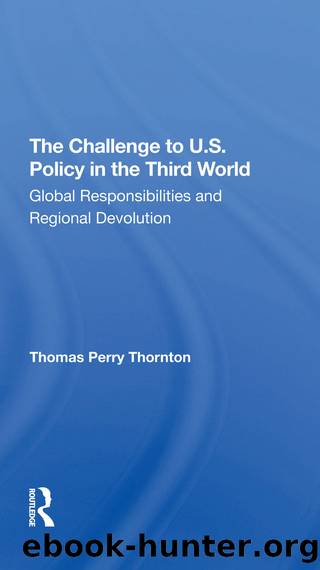
The Challenge to U.S. Policy in the Third World: Global Responsibilities and Regional Devolution by Thomas P Thornton
Author:Thomas P Thornton [Thornton, Thomas P]
Language: eng
Format: epub
Tags: Political Science, General
ISBN: 9781000315226
Google: aNDKDwAAQBAJ
Goodreads: 53097161
Publisher: Routledge
Published: 2020-01-22T00:00:00+00:00
South Africa
In this section I shall initially address Africa13 as an entity, although its states are too diversified to justify this approach. Common traits of poverty and underdevelopment have evoked some useful economic cooperation (the African Development Bank) and provided an initial framework for potential aid donors to think about Africa, but the economic realities are much too variegated to permit a continentwide approach. African nations come from a wide range of colonial backgrounds, and the colonial experience was too short to build the kind of common and effective structures that colonialists left behind them when they departed Asia.
The system's boundaries are geographically clear, but cultural differences deeply divide north and south, and the countries of the northeast quadrant have close relations outside the area, so that the Horn and Egypt-Sudan participate in world politics as Africans only to a limited extent. The Arabic-speaking states are also more or less closely tied into the politics of the Middle East. The remaining bastion of white supremacy in Africa, the Republic of South Africa, stands apart from the rest of the continent. Desperately desirous of acquiring a white, European, and northern identity, it plays a negative but highly important role in shaping whatever continentwide unity Africa can muster and has stimulated some very effective subregional cooperation.
Given Africa's lack of an objective basis for unity and its plethora of states and ministates, the continent should have been the scene of continual internal fighting. However, Africans have not only done a remarkable job of suppressing conflict but they also have achieved a useful degree of working unity on a number of political issues. This accomplishment is perhaps based on the time and manner of Africa's liberation from colonialism. Most of Africa's nations became independent within a few years, and few enjoyed independence before 1960. By 1960, the outside world had developed a positive, almost romantic view of the emerging nations, and Africa was invested with a special auraâ one that the new African leaders exploited skillfully to reduce external pressure on them, whether from military force or other forms of intrusiveness.
The outside world was inclined to stand back from African developments and allow Africans to devise the continent's approach to the rest of the world. On one hand, the outside world was aware that many fragile entities in Africa needed breathing space to establish themselves; on the other hand, it felt a sense of guilt toward a continent whose human resources had been so ruthlessly exploited and a paternalism that survived from the metropole-colony relationships.
More important in haping international attitudes, however, were the facts that African issues were not terribly salient to much of the world, that the continent posed no threat to anybody, and that outside nations had no desire to become enmired in African politics. Although this attitude provided breathing space, it also ensured that when regional crises did arise, the United States and the Soviet Union would view Africa in terms of global issues of the East-West confrontation.
The potential for East-West
Download
This site does not store any files on its server. We only index and link to content provided by other sites. Please contact the content providers to delete copyright contents if any and email us, we'll remove relevant links or contents immediately.
| Anthropology | Archaeology |
| Philosophy | Politics & Government |
| Social Sciences | Sociology |
| Women's Studies |
The Secret History by Donna Tartt(19086)
The Social Justice Warrior Handbook by Lisa De Pasquale(12190)
Thirteen Reasons Why by Jay Asher(8909)
This Is How You Lose Her by Junot Diaz(6886)
Weapons of Math Destruction by Cathy O'Neil(6279)
Zero to One by Peter Thiel(5801)
Beartown by Fredrik Backman(5754)
The Myth of the Strong Leader by Archie Brown(5507)
The Fire Next Time by James Baldwin(5442)
How Democracies Die by Steven Levitsky & Daniel Ziblatt(5218)
Promise Me, Dad by Joe Biden(5153)
Stone's Rules by Roger Stone(5087)
A Higher Loyalty: Truth, Lies, and Leadership by James Comey(4962)
100 Deadly Skills by Clint Emerson(4925)
Rise and Kill First by Ronen Bergman(4788)
Secrecy World by Jake Bernstein(4753)
The David Icke Guide to the Global Conspiracy (and how to end it) by David Icke(4717)
The Farm by Tom Rob Smith(4507)
The Doomsday Machine by Daniel Ellsberg(4490)
